Showing posts with label Political Economy. Show all posts

Tuesday, 14 October 2014

Charles Tiebout at 90

It escaped my notice that the man behind the Tiebout Model (short for "feet voting"), Charles M. Tiebout, would have turned 90 on Sunday last week had he had as long a life as his insights deserved. Alas, he died suddenly, in his 40's, in 1968, but I belatedly celebrate his memory with a blog post on the Tiebout Model, his most famous brain-child.


The Tiebout model says that perfect competition between local political jurisdictions ensures an efficient supply of public goods. Perfect competition here means that there are no costs of migration, so that if Town A has better street lights but a higher sales tax than Town B, those who do not mind paying more for their purchases while having more ample light on the streets move to Town A and the rest move to Town B.


Obviously perfect competition is unlikely to hold, but the essence of the Tiebout Model is hard to escape when looking around oneself. If a local community decides to tax high-income earners at a higher rate than low-income earners, it will quickly lose most of the former. This is not necessarily so if this is done at the country level where movement costs are greater (compare moving abroad to moving to the neighbouring municipality). This implication of the Tiebout Model is evident in the fact that the world looks pretty much like what Tiebout predicted. Local governments have little to offer high-income persons by way of services, so cannot really tax them as much as can nations.


Chances are that most readers of this blog post, if they have ever moved house, have based some part of their decision on the tax-services bundles available in their destinations under consideration. If so, they act according to the Tiebout Model, works in several other ways, too, including if local governments engage in the production of private goods, such as schooling: In a celebrated paper (gated) from the year 2000, Stanford Economist Caroline Hoxby shows that competition among public schools benefit school quality as judged by available measures and Professor Hoxby's ingenuity. This adds a great deal of relevance to the Tiebout Model since pure public goods are few and far between.


There are ways of attacking the Tiebout Model, of course. For instance, one could belabour its assumption of perfect mobility, which does not hold for land and buildings. However, this critique is only partially successful, because the value of such stationary objects depends on the quality of human genius that tries to make something out of it. If land is taxed a lot by one local government, it is apt not to be as well developed as the land in the neighbouring jurisdiction in which it is lightly taxed.


EconLog blogger and GMU Economics Professor Bryan Caplan, whose judgement I respect immensely, has challenged the Tiebout Model on the grounds that it really deals with non-profit competition, which fails to provide the necessary incentives for the Tiebout Model to hold:
"If a business owner figures out how to produce the same good at a lower cost, he pockets all of the savings.  If the CEO of a publicly-held corporation figures out how to produce the same good at a lower cost, he pockets a lot of the savings.  But if the mayor of a city figures out how to deliver the same government services for lower taxes, he pockets none of the savings.  That's how non-profits "work.""
I find his critique unconvincing. Armen Alchian pointed out in his classic paper 'Uncertainty, Evolution, and Economic Theory', that whatever an actor does will result in an enhancement or a reduction in his capacity to survive. Thus, if firms choose strategies randomly, those that come closest to maximizing profits survive and the others are successively eliminated, so that it looks like firms maximize profits in the end. Similarly, local governments may behave randomly and those who offer "good" tax-services packages will gain population at the expense of others.


There would have to be different incentives to behave "badly" for Tiebout competition not to work, but I don't see them. Probably failing local governments would attempt to learn from thriving ones. I am also unsure whether non-profit competition really is applicable to this case since politicians could be crooked (and probably frequently are) and thereby extract some tax theft from the population, which seems to give them an incentive to increase the tax base.


So to me, the Tiebout Model looks like it is holding up very well. Tiebout thought of it as a graduate student and had it published in 1956, so his brain-child would be 58 years old this year. Every parent should live to see his children, including brain-children, reach that age. It is a tragedy that Tiebout did not. I hope it gave him great satisfaction to imagine how economists and otherwise interested individuals might continue to experience many hours of deep spiritual joy from his work long after his demise which proved so untimely. I know he would not have been wrong.

Friday, 10 October 2014

Good Intentions Are Overrated

There is a lot of talk about this year's joint winner of the Nobel Peace Prize, Ms. Malala Yousafzai, but amidst all of it, I cannot find any information about what she has actually done. My ignorance is as deep and vast as the ocean, so maybe she actually has real accomplishments, but what appears to be normally mentioned as her main feats are talks and writings which advocate more education for girls in Pakistan and elsewhere. Now there is nothing wrong with any of this (maybe education is overrated and so she proposes bad policy, but she has the right to do that as far as I'm concerned), but I do not see why it should be worth £860,000 or $1.4 million (then again, the error-prone gentlemen in Oslo have, as far as I know, not violated anyone's rights by awarding the Prize to a great many feeble choices, so I guess that would make it OK).

Yet, awards like this devalue peace. Ms. Yousafzai wants to be a politician. If my impression is correct that she has never actually accomplished anything, never achieved any of the change she frequently talks about (which is OK for a seventeen-year-old), then her career choice means she will continue doing that forever. Remarkable statement? Not at all! If politicians were all about changing the world (for the better or for the worse), we would see a lot of policy changes whenever a new party comes into power. We quite palpably see extremely little of that sort (gated example here), meaning that politicians probably do what popular opinion, or some function of it, tells them to do, rather than influence it. That is why Ronald Reagan said that politicians have a great deal in common with workers in the world's oldest profession.

Ms. Yousafzai has spoken in favour of education for girls which is about as platitudinous as it gets unless one gets into the messy details about the ethics of craving positive rights, or about the economics of third-world education for girls, which I believe, suggests that it reduces domestic violence, but fails to impact policy views or voting intentions (some evidence here). But the yokelry and even most of the gelehrten do not go this deep and tend to think in simplified terms such as "education-good". Not that they are mentally defective; they very likely only lack incentives to think more deeply. So Ms. Yousafzai's campaign for girls' education hardly needs to influence anyone. Things are different in Pakistan, of course, and her very brave outspoken style would not always be platitudinous there, but she is rewarded and seems to be best liked where her words offend no-one and are met with disagreement by rather few (though possibly by many who are well-versed on the issues, I don't know). Would she have received the peace prize if she had campaigned against, say, agricultural subsidies or the minimum wage? Their abolition would surely benefit the world while avoiding the issues of positive rights and difficult cost-benefit analyses, but unlike education they do not enjoy widespread support.

Consequently, if Mr. Jagland and the other members of the Peace Prize Committee are really serious about peace, they should award the price to people or organizations who are likely to bring about more of it in this world. They have got some choices right, like Norman Borlaug and possibly the one to Muhammad Yunus (the evidence on the impact of microcredit is mixed, though I believe theoretically their case is a good one), but this one, the one to the EU (for preserving peace in Western Europe since the end of WWII - have they ever heard of the post hoc, ergo propter hoc fallacy?), the one to POTUS, to Jimmy Carter, Mikhail Gorbachev and a vast array of others, can do absolutely nothing for peace. Professor David R Henderson of EconLog has remarked that some of these prizes could actually promote war, since for a politician to be a peace dove it helps if he has first got himself into a violent conflict.

Again, I don't mean to say that Ms. Yousafzai has not accomplished anything and she is clearly a brave young woman for being outspoken in the face of threats; I merely say that I have not heard of anything she has done. I have looked, but I could have missed it. What seems to be a much more defensible proposition than that she has accomplished great things is that she means well. But given their beliefs, everybody means well. The real trick is to actually do something good. Certainly my own accomplishments are very few, but if my impression of Ms. Yousafzai is correct, maybe mine are more numerous than are hers. If the prize money is taxed, I'm hoping to receive a quiet ceremony next year so that it will be easier to hide the income from the tax authorities.

Friday, 29 August 2014

The Political Economy of Duckburg - Instalment 3: The Alleged Imperialist Ideology

When Scrooge, Donald and Huey, Dewey and Louie travel away from Duckburg, they encounter foreigners of different characters, some peaceful, others bellicose; some enlightened, others lazy and stupid. The book by literary critic Ariel Dorfman and sociologist Armand Mattelart, How to Read Donald Duck: Imperialist Ideology in the Disney Comic, which I mentioned in my preceding instalment on the topic of the Political Economy of Duckburg, argues that the Ducks spread a market ideology to the Third World or really anyone outside of the Bourgeois sphere, a world of witches, villains, and uncivilized foreigners.
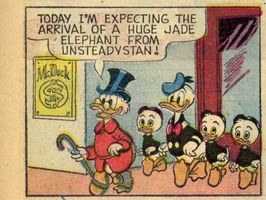
In the action-packed classic 'The Treasure of Marco Polo' (Uncle $crooge 64), there is arguably some material for this sort of skewed reading. In this story, Scrooge is eagerly anticipating a jade elephant from the country of Unsteadystan, a somewhat unruly country, as its incredibly well-crafted name suggests, which I presume is to be found somewhere in Asia. There is a problem with the shipment and only the elephant's tail arrives, so Scrooge and nephews have to travel to Unsteadystan to retrieve the remainder of the valuable mammal made of jade. Upon reaching their destination, they are shot at and when trying to get to Duckburg's Embassy, a militant Unsteadystani throws a bomb at it which demolishes the building.

In some parts of the world, there is civil war, so although foreigners are not always shown at their best, representing their conflicts is quite accurate. In other parts of the world, people's work habits are not quite in line with the Weberian notion of the Protestant Work Ethic (perhaps due to bad institutions, or who-knows-what), which is the topic of 'Volcano Valley' (Donald Duck Four Color 147), a story in which Donald and his nephews go to the titular nation, whose inhabitants are pathologically lethargic to the point where they are normally found reclining against their low-quality buildings, and stupid to the point where they are unaware of milk.

Other stories feature witch doctors (such as 'The Great Wig Mystery' of Uncle $crooge 52, in which poor natives share but one telephone with a hotline to the World Bank!) and civilized but evil powers like Brutopia (featured, for instance, in 'A Cold Bargain' of Uncle $crooge 17 - its first appearance, I believe, whose coat of arms is a pair of hand-cuffs and a hammer). Yet, it would be in error to accept this picture of foreigners as representative of the Duck Universe created by the great Duck Man Carl Barks, who wrote and drew all of these stories. Stories such as these get a lot of publicity because the foreigners have such a long list of shortcomings, but a representative sample of comics would palpably not show the "capitalist" world centred around Scrooge with such comparable favour. (Not that it would be in error to do so, for the free market system is indeed full of great advantages.)
 
Scrooge McDuck is often considered the archetypal capitalist-duck and even though he is quite affable and thereby gives a fairly positive impression of wealthy men (or ducks), the moral of a tonne of stories is that he should not overreach in his quest for gold, or he will disrupt a delicate harmony that foreigners often represent. Nowhere is this better illustrated than when Scrooge goes to the land of Tralla-la (Uncle $crooge 6). He does so because he is temporarily sick of money and the natives in the idyllic Himalayan Valley of Plenty offer every piece of evidence that money - and indeed every quest for material wealth - is a cancer. This story is clearly no defence of capitalism or of the Western (Duckburg) Way; while the free market certainly tolerates beatnik types who worship at the Buddhist altar, it also tolerates people's striving to increase upon what they have, a way of life which would nevertheless not be acceptable in Tralla-la.

The Peeweegahs in 'Land of the Pygmy Indians' (Uncle $crooge 18) offer another example of foreigners having reached a better way to live than that of smoggy "capitalist" Duckburg. The tiny Arabs of 'Pipeline to Danger' (Uncle $crooge 30) provide another sympathetic view of non-Duckburgers, as do the Indian-like egg eaters of 'Island in the Sky' (Uncle $crooge 29). At other times, natives appear to be just like people in general, enjoying dance and fun and otherwise working hard, like the Indochinese people of the wonderful story 'City of Golden Roofs' (Uncle $crooge 20). This is also tolerably close to how the people of Plain Awful are depicted in the classic 'Lost in the Andes' (Donald Duck Four Color 223), with differences mainly due to the paucity of almost any natural resources barring the chickens which lay square (or actually cubic) eggs. In all of these stories but the last two, Scrooge, in one way or another, must heed values other than his selfish interest in money. And there are many, many additional examples.

If Scrooge is frequently taught lessons of "social responsibility" in this way, the stories can only teach that "capitalism" is socially most useful when greed is strictly bridled. This is hardly "capitalist imperialism". By contrast, Scrooge's main rival entrepreneur in the Barksian view, Flintheart Glomgold, appears to make his money by lies and deceit. Flintheart's greed is unbridled and is depicted as something bad since he is clearly evil. Moreover, he is not as successful as Scrooge when it comes to making money, losing to him - albeit narrowly - in 'The Second-Richest Duck (Uncle $crooge 15) and in 'The Money Champ' (Uncle $crooge 27). (On the other hand, Scrooge's other main rival, John D. Rockerduck, never does anything really bad in the one story in which Carl Barks used - and invented - him: 'Boat Buster' of Walt Disney's Comics and Stories 255.)

Thus, Scrooge's "human-faced capitalism" is frequently quite lenient on the Third World and on natives, who frequently manage to teach "lessons" of better ways to live. Foreigners are sometimes indolent and ignorant, but culturally and spiritually advanced at other times. In light of these facts, it is hard to see any justification for the "imperialist" label.

This is the last blog post of the series on the Political Economy of Duckburg, though I will certainly return to the Ducks in future. Instalment two on the political economy of Duckburg is here; the first instalment is here.

Thursday, 24 July 2014

The Futility of Advocacy

Many stories are themed in a way such that two (or more) sides are in a struggle for local or world domination (Star Wars and even Björn Kurtén's terrific award-winner Dance of the Tiger come to mind). I wonder why the "good guys" should get so much credit; what reason is there to think they will act differently if in power? After all, if conditions are a certain way under the "bad guys", that is proof that rulers can make things go bad. Maybe the protest songs are right and successful rulers are all the same?

Of course, absent music, there are also other stories which purport to illustrate the difficulty for putatively powerful men to accomplish change. For instance, Robert Graves' I Claudius and its sequel Claudius the God depict the stuttering Roman emperor as a surprisingly cunning Republican, who nevertheless fails to resurrect his cherished system.
 
The reason Claudius failed to change the system is that "power" is demanding, a theme I have touched upon earlier on this blog (and here, too). To get it means to be obsequious to the right individuals, in particular to those individuals whose support, if withdrawn, does the most damage to one's continued sway. Those supporters, in turn, probably depend on other individuals, and so on. Everyone in this system has certain things he wants out of those in charge. As long as the dominant wish is not policy that is based upon clear-headed reasoning, this means that advocacy has the odds against it from the beginning.

Advocacy is tricky because all the individuals who exert even the tiniest pressure on politicians - which is to say everyone who adjusts his behaviour to public policy, adjusts his behaviour to others' adjustments to public policy, or votes, or just plain "everyone" - have next to no incentive to find out what good policy really is, and about the same incentive to follow their politicians' actions to make sure they adhere to good policy. This is because doing so will have no positive effects on one's own well-being, since one person is rarely going to be pivotal in collective decision-making. Time is scarce, so the individual had better spend it on things which might have some impact.

Thus, the door is opened to interest groups to control public policy. This does not have to be bad, but compared to a universe in which logic and evidence get full respect, policy will suffer. But even without interest-group pressure, rational biases (such as those explored by Bryan Caplan in his book The Myth of the Rational Voter) can help explain democratic shortcomings. 

There are many issues on which logic and evidence provide rather clear policy recommendations, on many consequentialist as well as deontological grounds. Yet, policy repeatedly fails to respect advice based upon such logic and evidence. For instance, minimum wages destroy bargaining options and kill jobs, compulsory military service (even disregarding its ethical shortcomings) is costlier than is a professional army (or no army) and free trade beats restricted trade.

Imagine devising a really clever argument in favour of, say, free trade. It is so clever that anyone who spends two seconds listening to it is instantly swayed forever. That still does not do away with the fact that it is in the self-interest of very few people to make sure that elected politicians follow good policy, and it still does not do away with the fact that many voters - even while convinced of the general beneficence of free trade - have a special interest against free trade in their particular sector.

The world is usefully thought of as being in equilibrium. It is not all bad, because it means we have a fairly stable business environment and of course many things are hunky dory on Tellus. But to change an equilibrium requires changing the rather mighty pressures which bring it about, and advocacy appears ill-suited at that. Perhaps the best one can do is to vote with one's feet. Maybe seasteading will improve migratory choices?

Monday, 21 July 2014

"Independence" for the Scots?

There is presently a lot of talk about the Scottish referendum in September to determine whether it shall become a nation independent from the rest of the UK. I believe the Union has a lot going for it; English-Scottish ties are legion in people's professional and social lives with a lot of intermarrying and cross-border migration, so in those respects two separate nations with concomitant border-control nonsense could only make things worse (though need not necessarily do so; of course). There is in fact nothing too distinctive that separates Scotland from the rest of the Union. It is North Britain, really, and England and Wales are South Britain.
 
Yet, there are advantages to an increasing number of nations in the world. Since there is only so much surface on Tellus, more nations means smaller nations. Small countries should tend to be more open, because relying on domestic production is more difficult. Also, migration to "competing" political jurisdictions should be easier the smaller is the "own" jurisdiction, encouraging good policies to be adopted.
 
I can think of a couple of secessions which were followed by neat developments: Hong Kong (though I believe it took a while to really prosper) and Taiwan became much richer than Red China. Finland grew healthily after its independence from then-revolutionary Russia. Other cases are perhaps not so clear, though the amputated countries may not have done much better either (Eritrea, the Republic of Ireland may be examples of secession being followed by relative non-prosperity, although I am not an expert on these countries, particularly not Eritrea).
 
The new states after the Soviet break-up have been a mixed bag, but I am not sure there is one among them that has fared much worse relative to its initial position. And others have done very well. I know much too little about Pakistan and Bangladesh to be able to judge those cases, but maybe there is a slight tendency for secessions to be followed by positive developments (but are there adverse consequences for the amputated countries which cancel out the good things?).
 
In the particular case of Scotland, competition with Westminster will likely intensify due to the presence of Diasporas, both south and north of the border, easing transitions for Britons voting with their feet. Technically, a more decentralized Britain could accomplish the same thing sans any secessions, and what has been known as "Devolution" (essentially more "home rule") has meant small steps in this direction. Devolution currently means, as far as I can understand, that Scotland presently gets money to spend from Westminster without having to worry about how to raise it (I think the Edinburgh Parliament can adjust (some?) Scottish tax rates up or down by three percentage points). This is of course an unfortunate arrangement, but again does not technically require secession to be solved.
 
I am ambivalent about the issue. As I say, the Union has a lot going for it and secession is by no means logically required in order to have some things that would benefit Britons (and indeed everyone) today. Yet, it is possible that secession would be a good way of bringing them about. More radical and real Devolution would be my preference, but if that is off the table I am not sure what to think.
 
(PS. "Independence" is in quotation marks in the title of this blog post because no Scot would really be independent whichever way the majority votes in September; they will still be forced to pay taxes and obey rules imposed by third-parties which no Scot might choose for himself. The only difference is that the third party would then be a different government.)

Saturday, 19 July 2014

Schumpeter's Calculation and the Present State of Things

In his great book Capitalism, Socialism and Democracy, Joseph Schumpeter envisioned further economic growth eliminating "want" (an unfortunate choice of word, since wants are really limitless, but what is meant is destitution or something like that) in just a few decades. The kind of economic growth which would achieve this immense feat would have to be in line with the growth numbers which had been seen during the past century or so up to his writing the 1947 edition of the aforementioned book. On page 67, for instance, Schumpeter notes the availability of modern dentistry to workmen which Louis XIV would not have obtained even if he had spent all his wealth. On page 69, Schumpeter continues:
"Now if the system had another run such as it had in the sixty years preceding 1928 and really reached the $1,300 per head of population, it is easy to see that all of the desiderata that have so far been espoused by any social reformers - practically without exception, including even the greater part of the cranks - either would be fulfilled automatically or could be fulfilled without significant interference with the capitalist process. Ample provision for the unemployed in particular would then be not only a tolerable but a light burden."
The emphasis is in the original. According to the BLS's inflation calculator, $1,300 in 1928 is $17,963.80 in 2014, well below even half of the American GDP per capita. So by the Great Austrian's reckoning, spending on transfer payments should be a very low fraction of GDP, indeed. Yet the welfare state consumes a lot more today than it ever has before. For instance, Charles Murray's Coming Apart cites the figure $1,500,000,000,000 (called a trillion and a half in America; I wonder if numbers have ever got this big in the UK, but Britons would call the figure one and a half billion) spent purely on income transfers in America, and throughout the West, total government spending as a share of GDP is typically around 40 per cent.
 
Now consider the $1.5 billion (or "trillion") figure and relate it to what Schumpeter had to say about eliminating want. It comes to almost $5,000 per American (of whom there are almost 320 million according to the Census Bureau), which is not that much less than one third of the $1,300 per-capita GDP in 1928 that Schumpeter nicely argued would suffice for wants to be eliminated "without significant interference with the capitalist process". But almost a one-third of per-capita GDP being spent on transfers is surely significant interference. Yet there remains poverty, although it is incredibly rare by world standards. What gives?
 
These facts indicate to me that the welfare state is not really about helping poor people. Moreover, there is the suspicion that there are laws in social science which make it incredibly difficult for welfare programmes to fulfil their ostensible purpose. One such candidate is Director's Law, named after University of Chicago Law Professor and Economist Aaron Director. It is not really a "law" as much as a vast and coherent set of empirical findings, for instance that tuition at fancy universities is often subsidized even though college students typically come from fairly affluent families.
 
However, there is some logic to Director's "Law", independent of observation. If a welfare programme is designed to help the poorest decile (say), it is plain that this is paid for mostly by persons far richer that that. The poorest decile is not a very useful group for office-seeking politicians, who must seek the approval of many more people than these in order to gain power (besides, people this poor tend not to vote much). Consequently, the winning proposals will have money shifted from fewer people than 90 per cent of the population, and to more people than just the poorest decile. Programmes specifically directed at the poor will tend to go unfunded.
 
What about expanded programmes? Everyone wants to be a beneficiary of such programmes, so they might easily grow a great deal, but once they have grown enough, the bottom ten per cent may no longer be such a valuable part of whatever coalitions form. Expanded programmes are palpably more attractive to interest groups than are narrower ones, and so those who can organize politically will tend to secure the benefits for themselves. Thus, farmers and other small and non-poor groups appropriate a lot of transfer money by good lobbying. Again, the poor folks lose out.

In addition, the poor may tend to be disadvantaged in utilizing whatever programmes for which they qualify. To get good health care, it helps to be articulate and to already know a bit about the system (for instance, by having friends within it), traits which the poor may well possess, but perhaps not as much as middle-class individuals. Services directed at poor areas may also be at a disadvantage when it comes to attracting talent to provide them. I can imagine good teachers shunning schools in poor areas. Raising the salaries in those schools will attract better talent, but as has been shown, this is politically difficult to do.

Schumpeter's calculations were surely correct and, on merely technical grounds, poverty could be eliminated today even with a much smaller government. It just happens that that is not how politics works.

Friday, 11 July 2014

Brave New Auctions?

A Swedish glass manufacturer has recently held an auction in which heart rates and how much one sweats when viewing an object were measured. It then awarded the object to the person judged by these measures to "like" it the most. This news made me think of topics in my recent review of Professor Richard Layard's old book Happiness. If the goal is to maximize measurable happiness, this seems to me to be the way to go. It also seems to me to be a profoundly bad idea for whole societies to adopt (except on this small-scale and voluntary basis).

In my aforementioned review, I did not touch upon a critique of utility (as well as of happiness) due (as many other profound insights) to the late Robert Nozick, but it fits well here. The critique goes as follows: what if some person is found to have intense positive feelings about a great many things, even after already possessing a great deal of wealth? Such a person would be treated like a god in a society run by the auction's principles, exactly like the Nozickean Utility Monster.

A society run along these principles would neglect every individual (even if it happens to be every individual bar one) who cannot muster the same positive feelings as can the utility monster. This of course violates the dignity due to the individual and his rightfully obtained property. Imagine going shopping only to find the clerk reluctantly handing out your favourite breakfast cereal to a needy individual whom you would immediately outbid in a standard auction.

Fortunately, the chances of the emotion-based auction's principles actually being implemented as legislation are low. This is because objects are costly to produce and it plainly pays more to produce them for those most willing to pay (although a high willingness to pay would probably overlap very frequently with a great intensity of positive feeling). The system would quite palpably be commercially inferior to a vast array of alternatives, and the stationary bandits in charge of nations care a lot about commercial success.
 
HT: MR

Friday, 27 June 2014

Why Would It Have Been Worse?

Art Carden is back to writing about, and linking to, interesting stuff on EconLog. Today's post contains a link to a debate between Professors Bryan Caplan and Jan Ting about whether war is ever justified. At one point, the latter claims that things would have gone worse in many, many places - and on net - throughout the world sans American intervention in World War II. Caplan asks how Ting could know this, and the answer is, of course, that he could not.
 
So the issue is whether intervention in the face of such radical ignorance could be advisable. Maybe one argument in favour of intervention is that the intervening country is relatively civilized and has an enviable standard of living and relatively good values. How could the intentions be anything but good? And maybe the threat of intervention keeps would-be fascists on better behaviour? We are still ignorance, but maybe these factors adjust the odds?
 
I think basic price theory argues for a "no" on the second question, and for a retort which spells "irrelevant" to the first one. Firstly, politicians competing for power within the foreign potential subject for intervention may well resist internal pressure (say, by interest groups or by people - Machiavelli argued that even despots must be responsive to "popular will"), but if this pressure is really for a significant change in policy, some other politician, less averse to the risk of foreign toppling, will win in a show-down with the incumbent.
 
Secondly, on the issue of whether the civilized status of the intervening armies' government matters, the intervening government is clearly more responsive to what is going on within it than elsewhere. And the point above applies here as well: within the foreign country, intervention in itself is not going to change anything as far as preferred policy goes. And as I have argued before, intervening powers may be unusually prone to failure with respect to setting up functioning institutions - which may well put the country back on its prior path anyway.
 
It seems to me that chances are that Caplan is right on this issue, but what other reasons are there to suppose that intervention might work?

Thursday, 19 June 2014

Roger Myerson's Commonsense Case for Decentralism

Over the past several years, Chicago Economics Professor Roger Myerson has blessed those around him by taking many opportunities to  discuss the numerous advantages of decentralization of political decision-making. Why does centralism lead to poor(er) performance by governments? Because it causes leaders to lack the local experience and knowledge necessary to be nationally successful (or less unsuccessful). Compare decentralized solutions to the state's management of local issues, incentives to learn about local issues will surely be greater under the former regime than under the latter one, in which conditions in any one area constitute only a small part of some pool from which rewards (rent) may be extracted.

For instance, Myerson explains the topical issue of the unruliness after the regime changes in Iraq (starting 2003) and Afghanistan (2001) by the fact that the rules instituted by the coalitions responsible for the regime changes are insufficiently decentralized. If anyone remembers Paul Bremer, he was the person in charge of the occupation of Iraq until the reconstructed constitution had been ratified, and he would not permit local politics to develop until this had happened. Other tendencies towards centralism have been seen in Afghanistan.
 
In a recent article written for the Huffington Post, Myerson applies his ideas to the recent brouhaha in the Ukraine. Myerson argues that provincial governors, the supervisors of state administration in the provinces of the Ukraine, have neither knowledge of, nor significant stake in, local conditions in their provinces, because they are appointed centrally. By contrast, locally-elected counsellors are better at determining where the winds are blowing in their provinces. This local knowledge comes in handy when Vladimir Putin gives them a ring, perhaps with promises of rewards for various pro-Russian manifestations which could potentially result in annexation. Myerson highlight's Putin's skill in manoeuvring local conditions, a likely consequence of his experiences working within the local authorities in St Petersburg, as well as with provincial relations to Moscow under Yeltsin.
 
I strongly agree with Myerson that decentralization is the best way of stabilizing the situation in the Ukraine, as well as in other unruly parts of the world. However, there are probably many ways of achieving this outcome. For instance, the nationally-appointed governors of the Ukrainian provinces mentioned above could be paid for performance in their provinces, incentivizing them to gain more local knowledge. This will not look very decentralized, because the governors are still appointed as before, but - depending on the exact design of the reward structure - the effects could be identical.
 
The question remains why states would become centralized to begin with. One explanation is that foreign interposing in national affairs is an added channel for rewards and punishments for the national leaders, which may cause them to neglect local conditions when strings are attached. I don't know, but I think this may be something for me to consider as I resume my hiatus.

Saturday, 24 May 2014

Voting Schmoting

These days, citizens of EU countries have the opportunity to decide the composition of the EU Parliament for the next five years. Typically, there are hundreds of candidates to choose from. EU citizens are evidently expected to acquaint themselves with all of them, their character, their most cherished issues and whatever else is a criterion for whether a politico might have one's vote (and there is both theory and evidence to suggest that it does not matter for whom one votes anyway).

How does anyone have time for this? After jobs and hobbies, family and friends, why spend time sifting through the popinjays and the charlatans searching for someone whose views might correspond to one's own? I suspect only very few people do this, yet very many people actually do vote and look down their noses at people who abstain.

For the vast majority of good, decent folks, to vote intelligently is not to vote at all.

Wednesday, 14 May 2014

Some Economics of Moral Thought

"Legislation deals with numbers and with whole classes of men; morality deals with individuals." - A. V. Dicey, Lectures on the Relation between Law & Public Opinion in England during the Nineteenth Century
There are many problems one faces in life and one must decide how much of one's scarce time to allocate to each of them. Economics teaches that 'common pool' problems usually receive very few resources, including time, from any given individual, because careful thought, or restraint of rapacity, with regard to the management of said common pool is unfathomably unlikely to matter when there are many individuals. Thus, it easily happens that we get too much pollution and overfishing of seas.
 
Some of the problems which many of us face are ethical. There are probably too many of them for anyone to be really confident in his response to any given individual problem. In a world of common property, such as legislation, many problems are taken out of the individual's moral horizon. This is very much akin to the economic problem of common pool management. To the individual for whom time is scarce, a moral problem is more important the greater is his voice in proportion to those of others on the issue, and the individual has virtually no voice in collective decision-making. I believe most of the potential lessons which follow from this reasoning are in a classical liberal vein.
 
Here are some examples: In civil society, few people take others' property. Indeed, doing so is considered theft. But in the political realm, in which the voice of the individual is infinitesimal, taxation is mostly considered OK. If a person screams obscenities about others and shouts about how he will slaughter them, his behaviour is considered to be on the brink of murderous in civil society, but in politics it can be justified if a war is being fought. If somebody decides to take up drugs, the reactions he faces in civil society may be admonitory or opprobrious, but the reactions from the political realm are quite often to imprison him.
 
Some of the time, the views prevalent in the political realm are sound and perhaps more so than the views in (parts of) civil society. For instance, being of a frowned-upon race will rarely (though not, of course, never) lead to a death sentence from the state, whereas he will be killed, without a sentence, in certain circles. However, while sometimes the state will defend sound moral judgement, it seems quite obvious from history that its usual move is to imperil it.

For instance, the Jim Crow legislation would never have been mimicked by civil society norms, nor would, of course, the Holocaust. Immigration restrictions condemn billions of people to inescapable poverty when the civil society response is for individuals to go wherever someone is willing to offer them gainful employment and accommodation. I submit that what is behind these differences in standards is individuals' rational decisions to economize on moral thought.

It is worrying that the same principles which cause overfishing and excessive pollution are applicable to moral thought, but I can't see any way around it. The sum up this post with another quote, the old one by Benjamin Franklin comes to mind: "No man's life, liberty or fortune is safe while our legislature is in session".

Sunday, 20 April 2014

What is the Point of NATO?

Tyler Cowen recently quoted a Financial Times article in which London City University's Michael Ben-Gad made the point that protective alliances such as NATO may not be credible in the long run. Quoth Ben-Gad:
"'Would the US and western Europe really go to war to defend the territorial integrity of Estonia? I think Estonia has reasons to worry. Narva is the most obvious place; it is almost completely Russian-speaking,' he says."
In other words, wars are really expensive and the fact that there is a military alliance is therefore not necessarily a guarantee that the alliance's members will be protected. I have made the rather elementary point before that countries risking loss of parts of their territories have every reason to avoid a costly war, and that if the rulers of the "aggressive" foreign country gain more than the present rulers lose, the former should simply compensate the latter in a peaceful way, rather than fight costly wars (see also this article by David Friedman, which touches upon similar issues).
 
Prospective members of NATO must, as far as I know, be approved by each current member, so there is some reason to suppose that members "care" more about each other than about outsiders. But there is nothing here to imply that bargaining about member countries' territories should follow principles different from the ones mentioned above. If the loss is sufficiently small relative to the compensation which may be offered, a NATO territory under dispute will be lost. What about territories outside NATO?
 
If NATO is interested in some region X, why should it matter to potential aggressors whether X is a member of NATO? Said territory can receive NATO backing provided the appropriate compensation schemes between NATO members are arranged. If not, the situation is qualitatively the same as NATO reneging on promises to its members in order to avoid expensive wars.

If this is true, what is the incentive to join NATO? More generally, what is the point of international organizations? Perhaps they are mainly a way to provide sinecures for politicians on hiatus from domestic issues? Maybe there is something in here akin to Ronald Coase's 1937 treatment of firms? Countries economize on transaction costs by being bound together in certain ways. Rather than seeking agreements on issues which members confront from time to time, general guidelines are drawn up which command certain actions.

If this is the case, one should have more confidence that recent agreements will be maintained than than that old ones will. Just like newly-hired workers are not likely to be laid off, it is unlikely that a recently agreed-upon treaty between nations will immediately fail since new circumstances are easier to foresee the nearer they are in time. However, many international agreements are non-binding. This fact would seem to throw the firm analogy out the window. At least it cannot apply to all collaboration between countries.

Some have suggested that declarations by international organizations can have ring effects, such that other actors will not associate as much as would otherwise have been the case with nations which have been condemned in one way or another by well-known international organizations. However, maybe follower-shunners would have done the same thing anyway, but make convenient use the first mover's actions?

So is protection by NATO credible? The stated rationales for international collaboration are not the actual reasons, but NATO could work anyway. In the end, I expect the bargaining issues in my previous post, mentioned at the beginning of this one, to hold. That wars occur at all is a queer fact from this point of view, but it should not change the conclusion that territories eventually end up within the political jurisdictions in which they are most valued. In the long run, and if NATO is truly about protection, there will be war. But this seems much too foolhardy and expensive an attitude to be real. So probably - and hopefully - NATO is not really about protection.

Friday, 18 April 2014

On Public Service Broadcasting

Chicago Booth's Matt Gentzkow was awarded the Clark Medal yesterday. In light of his famous paper with Jesse Shapiro on media bias, I thought I would offer my thoughts on the related issue of public service broadcasting. Because the slant (if any) of such outlets may function according to the same basic principles as those found by Gentzkow and Shapiro.

What the Gentzkow-Shapiro paper does is to scrutinize newspaper articles for phrases which show up disporportionately in Republican and Democratic speeches in the Senate. Estimating political slant in this fashion, they find that the political orientation of a newspaper is explained mainly by the preferences of its readers, rather than by the views of its owners. The consumer is King. It seems to me that the same should apply to state television.

In most of the world, the state is an active operator in the television business. This is usually funded by licence fees for owning a TV set, or through income taxation. Common arguments in favour are that such media outlets are free from commercial influence and interests and thereby provide more objective news and better coverage of high culture and other forms of entertainment which might be too narrow for commercial alternatives.
 
Given the results of Gentzkow and Shapiro, I would be inclined to believe that tax and licence payers get most value out of public service broadcasting when it closely matches their viewing preferences. Because a political decision could do away with public service broadcasting, this media outlet is sensitive to the views of its targeted audience just like newspapers are sensitive to the sentiments of their intended readers. In an efficient market for public policy, this should mean that mostly rather popular programmes end up reaching viewers of state television. It two politicians are otherwise the same, one of them improves his chances of election by proposing a way for the country's public service broadcasting company to show more intensely-valued TV shows. This makes it hard to see the difference between public service broadcasting and private alternatives.

If the argument in this post is sound, the real reason behind public service broadcasting cannot be the stated reason. (Or, maybe I simply have not heard the true stated reason yet.) Maybe propaganda becomes easier? At several margins, politicians could prefer some (indirect - since public service broadcasting is usually formally independent) control of what is said in the media to audience surplus. Politicians want more propaganda the greater are the benefits from influencing behaviour relative to the losses associated with failing to maximize audience suplus. What other rationales for public service broadcasting are there?

Friday, 4 April 2014

What Is Wrong with Hayek's 'The Road to Serfdom'?

This year marks the 70th anniversary of the publication of F.A. Hayek's famous book The Road to Serfdom. Its thesis is that democracy is imperilled by citizens' viewing it as a means to just about any ends they might have. One may think of it as two wolves and a sheep voting on what to have for dinner, a sort of doll's-house view of society in the sense that voters use democracy to order fellow citizens about.
 
Examples include demands for safety nets, public provisions of education and health care, etc. All of these policies use a measure of force to achieve their ends. One may approve of the policies anyway, of course, but the resources to achieve them must come from somewhere and this means individuals' scope to decide their own ends must necessarily decline. One can be served from a government tray, or one can decide how to put together one's own tray with whatever means one has.
 
Hayek argued that such tendencies must inevitably spell the end for liberty and indeed for democratic institutions, because once the erosion of freedom to decide individual ends has proceeded too far, the resultant state control over many, many aspects of life gives it, ultimately, the power to decide who eats and who does not, who prospers and who perishes. The many things at the state's command also necessitate delegation to committees and departments which cannot be subject to democratic choice, or they simply won't be able to run smoothly.
 
There is a lot more to the argument and I encourage everyone to read the book, but what I want to discuss here is why, even in countries in which governments tax around fifty per cent of GDP, tyranny does not seem to lure around the corner. With the growth of government having continued since 1944, why do Hayek's fears appear ill-founded?
 
I believe a big part of the explanation must be that there are built-in breaks in political competition which inhibit totalitarian tendencies. Hayek argued that the only thing that can stop creeping totalitarianism is a popular opinion which favours the liberal principles upon which democracy was once founded. But popular opinion has limited (although not nonexistent) influence on legislation. Given how little influence an individual voter has on political outcomes, it would be foolish to suppose that he keeps himself au courant with what politicians do.
 
This opens the door for special interests. On the surface, it might not seem like an improvement, but there is nothing to suggest that interest groups only favour illiberal policy. They are frequently at loggerheads over all sorts of issues, some wanting more redistribution but others wanting less. Candlemakers might petition the government to block out the sun, but tourist resorts will lobby against such a move. Various Green groups may lobby against GMOs, but if so they are likely to face some opposition, for instance from firms researching GMOs.
 
Furthermore, politicians may try to reap rents by taxing citizens whose willingness to pay for certain policy is relatively great, giving away a share of these rents to other citizens with a negative-but-lower-in-absolute-value willingness to pay for the selfsame policies. If clear-headed thinking is associated with greater willingness to pay, poor policy is at an inherent disadvantage. Of course, clear-headed thinking in politics may be very rare (I don't know), but it is conceivably a force opposing bad policy.
 
Another contender to explain why liberal democracy has survived is that the tax-to-GDP ratio has not climbed quite high enough yet. I think this is a poor contender reminiscent of Marxian explanations that capitalism must progress just a little more before the advent of the workers' revolution. I do doubt that any speck of freedom would survive if governments suddenly started taxing in excess of ninety per cent of GDP, but my favoured explanation above already covers this because the built-in breaks prevent that from occurring. And if what saves Hayek's thesis is that it has, at least so far, been impossible to go far enough, there just does not seem to be much point to Hayek's warning. 'Beware of the Hydra' would be a poor warning for the same reason. Because there is no Hydra.

Thursday, 3 April 2014

What's in a Name?

Imagine you want power above all else. "Public service" or "duty by one's nation" are mere catch-phrases without any real meaning. You will do whatever you deem necessary in order to hold sway. This is the kind of thinking that is behind a great deal of standard economic treatments of politics. If a politician does care about stuff other than securing sway, he will lose out to those more focused in their aim.

Strange, then, that the vast majority of the most eye-catching atrocities committed in the 20th century appear to have been committed with either communist or fascist parties in power. If politicians care mainly about power and less about policy, should not who gained power to commit these crimes have been a toss-up between whatever political forces were established at the time of the preceeding election, or between which movements were around to grab power when the country in question was last in an unsteady state? I have no good explanation for why totalitarian names should dominate. Why should not an established party on occasion have changed policy preferences to accommodate communist or fascist tendencies to prevent a party with one of those words in its name from coming to power? The atrocities would have been the same, but the perpetrators would have called themselves the Agrarian Party, the Democrats or the Conservatives. Why did this not happen?

Thoughts?

Tuesday, 1 April 2014

Pacifism and Political Economy (Speaking of the Crimea...)

EconLog's Bryan Caplan rightly criticizes The Economist Magazine today for a stunning lack of substance in discussing what attitude the West should take in response to recent Russian activities. It occurs to me that my post from a few days ago fits well with Caplan's case for pacifism, which can stand repetition: Sometimes, wars have arguably accomplished good things (though one cannot be too sure sans a counterfactual), but other times they have worsened life greatly (again, arguably: it is difficult to know what would have happened had things gone differently). Since, irrespective of final outcomes, the short-run costs are plainly tremendous, wars are to be avoided.

Similarly, from the more theoretical point of view of my recent post, if policy won't change as a result of military takeover, it makes no sense to resist invading armies. Maybe the idea that wars are not worth fighting would make it more tempting for foreign powers, unsympathetic to this idea, to invade, but for resultant policy to be different, it would have to be that the threat of war, now absent, impacts which policies are chosen. But there are many pacific threats which also influence policy (e.g. demonstrations, black-market activities...), so I am not sure how significant the threat of war is.

If my thoughts from a few days ago have any merit, it seems to me that they strengthen the case for pacifism, at least a little bit.