Showing posts with label War and Peace. Show all posts

Wednesday, 5 November 2014

Gordon Tullock

Today I was reached by the incredibly sad news that Gordon Tullock passed away on Monday, 3rd November, at age 92. These past few years have seen the demise of many of my great heroes, among whom Alchian, Becker, Coase, and now Tullock, stand out. What a dismal endeavour to go through the list in any detail. I never got to meet him, but the stories I hear all tell of an amazing character. Case in point: visited by what may have been the Governor of Virginia (if I recall the story correctly), then GMU Professor Tullock, always forthright, said to him: "So you're from the government? Very good. Then maybe you can do something about the leak in my ceiling". Actually these were also among the last words spoken between them.

Gordon Tullock is of course best known for his work on Public Choice and he was the founding editor of the eponymous journal, but his interests and articles showcase an astonishing breadth and depth of thought. He even had a publication in the Journal of Theoretical Biology. He wrote extensively on history and it is a great understatement to say that he was very well read. One article of his is 'An Economic Theory of Military Tactics', joint work with Geoffrey Brennan, in which they analyse the general's problem of getting the soldiers not to run away from battle. I have blogged about that article before, and several times about the late legend.

Tullock had a few paradoxes to his name. One, a wee note called 'The Purchase of Politicians' in the Western Economic Journal (now Economic Inquiry), says that political favours are bought for much less money than they reward, a phenomenon known as the Tullock Paradox which as far as I can tell lacks a satisfactory explanation. A better-known paradox of his is, of course, that of revolution: The individual faces great risk from participating in a protest against a tyrant, who might order the firing squads on the protestors, and the benefit he receives from doing so are hardly greater than what he would have got if he hadn't taken part in the protests.

With Tullock's passing, the world also loses a refreshing observation on the lack of necessity of formal training to be educated. Tullock never obtained a PhD in Economics even though he was surely among the two or three greatest economists to have been alive for over 40 years of Nobel Prize announcements and never received one - and a far greater recipient than many a Laureate. Tullock held a JD from the University of Chicago and only took one economics course for that degree. His works are rigorous without the formulae, which he would refer to as "ornamental mathematics". It is a tremendous loss to economic science that his example is no longer among us.

Of the tributes which I have seen, I particularly like the one by Professor David Friedman. Mine cannot compete, but I humbly add it to the pile, along with a piece of evidence as to how much Gordon Tullock has influenced my own thinking: I still do not know how yesterday's American election turned out. That will change soon enough with the number of interactions I have with others, but if it were not for them, I probably would not find out until I accidentally saw the headline on the news or maybe encountered it as part of some data crunching for a project.

We have lost a great economist and a remarkable character.


Sunday, 19 October 2014

What to Do if Enemies Are Mapping out a Country for Conquest?

Recent activities in the Stockholm archipelago, coupled with prior infringements of Finnish air space and of course the unruliness in the Ukraine, have sent people wondering what the best response is if Russia might be aggressive towards its neighbours. The best response for leaders may well be to spruce up their countries' militaries, because if they are taken over these people will lose their positions of power.

I am not saying there is any risk of a Russian invasion of any parts of Scandinavia. These activities were observed during the Cold War as well and of course no invasion took place then. Rather, entering the waters and air spaces of other countries might serve to extract benefits by bullying other countries into concessions. Still, the political leadership in Scandinavia may well benefit from increased military preparedness, so as not to appear too weak while making such concessions.

For the citizens, however, the best response depends, as I have said before, on the likely changes in policy which come from a more aggressive Russia, and in the limit on the likely policy changes which come from Moscow Rule. It is not obvious to me that these changes are big enough to justify increased outlays on weapons and on training people to commit murder. It might be that the bulk of the citizenry actually favour more of this kind, but the bulk of the citizenry lack incentives to make informed judgements, so that would not be strong evidence in any direction.

Case in point: Finland used to be a part of Russia from its war with Sweden of 1808-1809 until 1917. For over a century, it would seem to me that Finland was not very "russified". Finland held autonomous status as a Grand Duchy during all of this time and as far as I know, most of, if not the only Russian spoken in Finland today is by the numerous Russian tourists coming in to see Helsinki or other pleasant places. I also believe that Finland could set its own rules regarding a great deal of foreign trade as well as taxation and many regulations, but I am no expert so don't quote me here. At least culturally, Finland today is Scandinavian and apart from the beautiful Uspenski Cathedral and some other buildings not Russian in the slightest, so the status as a Grand Duchy must have meant something substantial.

The situation with a more aggressive Russia is very unfortunate, but my impression is that it would be far less unfortunate if the outside world responded as one does when stumbling upon an angry wasp: Do not move, especially not suddenly. Alas, this is not what has happened with sanctions and condemnations taking up much space in the newspapers. Neither Finland nor Sweden is a member of NATO, but it would not surprise me if this were to change given how things are going.

I don't know, but I reckon it would be a lot harder for anyone to kill another person knowing he was committed to non-resistance. It seems to me that nonviolence has its appeal from the fact that it is rare indeed for it to lead to the death of its practitioners by slaughter of their adversaries, so maybe there would be less death and destruction if countries gave this strategy a try?

Wednesday, 15 October 2014

National Defence as a Public Bad

In textbook treatments of price theory and of public economics, one invariably sees national defence cited as an example of a public good. But how useful national defence is surely depends upon the expected change in policy if a foreign power took over. If this change is for the better, then clearly national defence is only an impediment to amelioration; if the change is for the worse, the utility of national defence would depend upon how much worse and compare that magnitude to the costs. If the change is neutral, national defence is again a public bad.

One could argue that citizens want a national defence and so their preference for it makes it a public good. But why should citizens qua citizens know what is good for them? Facing virtually no chance of their opinion being pivotal to any national decision, they can indulge in whatever idiocy they want. I do not normally like the distinction behavioural economists make between decision utility and experienced utility, but it seems serviceable in this case. If citizens want national defence, that is just their decision utility talking, but in actual fact it could be that they are throwing money away. Maybe it is a purely normative issue, but it seems to me to be just as normative to refer to something with such ambiguous effects as a public good.

If one goes along and takes the right name to depend upon whether national defence safeguards against changes for the worse or just keep things bad, it would seem to me that national defence is to be referred to as a public bad in the countries which pursue the most horrendous policies (certainly it would seem a normative point to give a name like "public good" to racist polcies such as the nuking of areas containing people of a certain skin colour, wanted by racists). I have made the case before that policy may not actually improve from outsiders invading such countries, but of course if policy is about the same the war was wasteful and so national defence was a bad idea.

With no spending on the military in the countries pursuing the worst policies, the countries pursuing the second-worst policies face no threat of invasion from countries with worse policies anymore. Again, maybe invasions by countries with better policies would not actually result in improvements, but if things do not change appreciably it would seem that these countries also waste resources now by spending them on national defence.

In this way, we regress to a situation in which no country spends anything on national defence. This is an equilibrium because no country now has any incentive to spend money on protection, though the people in the countries pursuing the most horrendous policy arguably still have an incentive to change things somehow - just not by getting invaded. The operative assumption here is that countries which are invaded suffer only if policy is changed for the worse (otherwise why resist?) and that the risk that this happens goes away if the invading country is one pursuing better policy.

In equilibrium, national defence is a public bad. Outwith equilibrium there may be a point to it in countries with good policies at risk of invasion by countries with bad policies (though there are problems with this view, too), but still many countries today do not face any serious risk of that happening (e.g. Switzerland, New Zealand, Canada). If the language of economics textbooks took steps to approach value neutrality by calling national defence, say, a "public-bad-or-good(-but-probably-bad)", my guess is there would be no less national defence anywhere. It would be better language, though, and reflect better thinking. That's something.

Friday, 10 October 2014

Good Intentions Are Overrated

There is a lot of talk about this year's joint winner of the Nobel Peace Prize, Ms. Malala Yousafzai, but amidst all of it, I cannot find any information about what she has actually done. My ignorance is as deep and vast as the ocean, so maybe she actually has real accomplishments, but what appears to be normally mentioned as her main feats are talks and writings which advocate more education for girls in Pakistan and elsewhere. Now there is nothing wrong with any of this (maybe education is overrated and so she proposes bad policy, but she has the right to do that as far as I'm concerned), but I do not see why it should be worth £860,000 or $1.4 million (then again, the error-prone gentlemen in Oslo have, as far as I know, not violated anyone's rights by awarding the Prize to a great many feeble choices, so I guess that would make it OK).

Yet, awards like this devalue peace. Ms. Yousafzai wants to be a politician. If my impression is correct that she has never actually accomplished anything, never achieved any of the change she frequently talks about (which is OK for a seventeen-year-old), then her career choice means she will continue doing that forever. Remarkable statement? Not at all! If politicians were all about changing the world (for the better or for the worse), we would see a lot of policy changes whenever a new party comes into power. We quite palpably see extremely little of that sort (gated example here), meaning that politicians probably do what popular opinion, or some function of it, tells them to do, rather than influence it. That is why Ronald Reagan said that politicians have a great deal in common with workers in the world's oldest profession.

Ms. Yousafzai has spoken in favour of education for girls which is about as platitudinous as it gets unless one gets into the messy details about the ethics of craving positive rights, or about the economics of third-world education for girls, which I believe, suggests that it reduces domestic violence, but fails to impact policy views or voting intentions (some evidence here). But the yokelry and even most of the gelehrten do not go this deep and tend to think in simplified terms such as "education-good". Not that they are mentally defective; they very likely only lack incentives to think more deeply. So Ms. Yousafzai's campaign for girls' education hardly needs to influence anyone. Things are different in Pakistan, of course, and her very brave outspoken style would not always be platitudinous there, but she is rewarded and seems to be best liked where her words offend no-one and are met with disagreement by rather few (though possibly by many who are well-versed on the issues, I don't know). Would she have received the peace prize if she had campaigned against, say, agricultural subsidies or the minimum wage? Their abolition would surely benefit the world while avoiding the issues of positive rights and difficult cost-benefit analyses, but unlike education they do not enjoy widespread support.

Consequently, if Mr. Jagland and the other members of the Peace Prize Committee are really serious about peace, they should award the price to people or organizations who are likely to bring about more of it in this world. They have got some choices right, like Norman Borlaug and possibly the one to Muhammad Yunus (the evidence on the impact of microcredit is mixed, though I believe theoretically their case is a good one), but this one, the one to the EU (for preserving peace in Western Europe since the end of WWII - have they ever heard of the post hoc, ergo propter hoc fallacy?), the one to POTUS, to Jimmy Carter, Mikhail Gorbachev and a vast array of others, can do absolutely nothing for peace. Professor David R Henderson of EconLog has remarked that some of these prizes could actually promote war, since for a politician to be a peace dove it helps if he has first got himself into a violent conflict.

Again, I don't mean to say that Ms. Yousafzai has not accomplished anything and she is clearly a brave young woman for being outspoken in the face of threats; I merely say that I have not heard of anything she has done. I have looked, but I could have missed it. What seems to be a much more defensible proposition than that she has accomplished great things is that she means well. But given their beliefs, everybody means well. The real trick is to actually do something good. Certainly my own accomplishments are very few, but if my impression of Ms. Yousafzai is correct, maybe mine are more numerous than are hers. If the prize money is taxed, I'm hoping to receive a quiet ceremony next year so that it will be easier to hide the income from the tax authorities.

Friday, 29 August 2014

The Political Economy of Duckburg - Instalment 3: The Alleged Imperialist Ideology

When Scrooge, Donald and Huey, Dewey and Louie travel away from Duckburg, they encounter foreigners of different characters, some peaceful, others bellicose; some enlightened, others lazy and stupid. The book by literary critic Ariel Dorfman and sociologist Armand Mattelart, How to Read Donald Duck: Imperialist Ideology in the Disney Comic, which I mentioned in my preceding instalment on the topic of the Political Economy of Duckburg, argues that the Ducks spread a market ideology to the Third World or really anyone outside of the Bourgeois sphere, a world of witches, villains, and uncivilized foreigners.
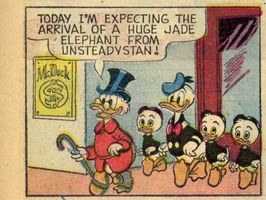
In the action-packed classic 'The Treasure of Marco Polo' (Uncle $crooge 64), there is arguably some material for this sort of skewed reading. In this story, Scrooge is eagerly anticipating a jade elephant from the country of Unsteadystan, a somewhat unruly country, as its incredibly well-crafted name suggests, which I presume is to be found somewhere in Asia. There is a problem with the shipment and only the elephant's tail arrives, so Scrooge and nephews have to travel to Unsteadystan to retrieve the remainder of the valuable mammal made of jade. Upon reaching their destination, they are shot at and when trying to get to Duckburg's Embassy, a militant Unsteadystani throws a bomb at it which demolishes the building.

In some parts of the world, there is civil war, so although foreigners are not always shown at their best, representing their conflicts is quite accurate. In other parts of the world, people's work habits are not quite in line with the Weberian notion of the Protestant Work Ethic (perhaps due to bad institutions, or who-knows-what), which is the topic of 'Volcano Valley' (Donald Duck Four Color 147), a story in which Donald and his nephews go to the titular nation, whose inhabitants are pathologically lethargic to the point where they are normally found reclining against their low-quality buildings, and stupid to the point where they are unaware of milk.

Other stories feature witch doctors (such as 'The Great Wig Mystery' of Uncle $crooge 52, in which poor natives share but one telephone with a hotline to the World Bank!) and civilized but evil powers like Brutopia (featured, for instance, in 'A Cold Bargain' of Uncle $crooge 17 - its first appearance, I believe, whose coat of arms is a pair of hand-cuffs and a hammer). Yet, it would be in error to accept this picture of foreigners as representative of the Duck Universe created by the great Duck Man Carl Barks, who wrote and drew all of these stories. Stories such as these get a lot of publicity because the foreigners have such a long list of shortcomings, but a representative sample of comics would palpably not show the "capitalist" world centred around Scrooge with such comparable favour. (Not that it would be in error to do so, for the free market system is indeed full of great advantages.)
 
Scrooge McDuck is often considered the archetypal capitalist-duck and even though he is quite affable and thereby gives a fairly positive impression of wealthy men (or ducks), the moral of a tonne of stories is that he should not overreach in his quest for gold, or he will disrupt a delicate harmony that foreigners often represent. Nowhere is this better illustrated than when Scrooge goes to the land of Tralla-la (Uncle $crooge 6). He does so because he is temporarily sick of money and the natives in the idyllic Himalayan Valley of Plenty offer every piece of evidence that money - and indeed every quest for material wealth - is a cancer. This story is clearly no defence of capitalism or of the Western (Duckburg) Way; while the free market certainly tolerates beatnik types who worship at the Buddhist altar, it also tolerates people's striving to increase upon what they have, a way of life which would nevertheless not be acceptable in Tralla-la.

The Peeweegahs in 'Land of the Pygmy Indians' (Uncle $crooge 18) offer another example of foreigners having reached a better way to live than that of smoggy "capitalist" Duckburg. The tiny Arabs of 'Pipeline to Danger' (Uncle $crooge 30) provide another sympathetic view of non-Duckburgers, as do the Indian-like egg eaters of 'Island in the Sky' (Uncle $crooge 29). At other times, natives appear to be just like people in general, enjoying dance and fun and otherwise working hard, like the Indochinese people of the wonderful story 'City of Golden Roofs' (Uncle $crooge 20). This is also tolerably close to how the people of Plain Awful are depicted in the classic 'Lost in the Andes' (Donald Duck Four Color 223), with differences mainly due to the paucity of almost any natural resources barring the chickens which lay square (or actually cubic) eggs. In all of these stories but the last two, Scrooge, in one way or another, must heed values other than his selfish interest in money. And there are many, many additional examples.

If Scrooge is frequently taught lessons of "social responsibility" in this way, the stories can only teach that "capitalism" is socially most useful when greed is strictly bridled. This is hardly "capitalist imperialism". By contrast, Scrooge's main rival entrepreneur in the Barksian view, Flintheart Glomgold, appears to make his money by lies and deceit. Flintheart's greed is unbridled and is depicted as something bad since he is clearly evil. Moreover, he is not as successful as Scrooge when it comes to making money, losing to him - albeit narrowly - in 'The Second-Richest Duck (Uncle $crooge 15) and in 'The Money Champ' (Uncle $crooge 27). (On the other hand, Scrooge's other main rival, John D. Rockerduck, never does anything really bad in the one story in which Carl Barks used - and invented - him: 'Boat Buster' of Walt Disney's Comics and Stories 255.)

Thus, Scrooge's "human-faced capitalism" is frequently quite lenient on the Third World and on natives, who frequently manage to teach "lessons" of better ways to live. Foreigners are sometimes indolent and ignorant, but culturally and spiritually advanced at other times. In light of these facts, it is hard to see any justification for the "imperialist" label.

This is the last blog post of the series on the Political Economy of Duckburg, though I will certainly return to the Ducks in future. Instalment two on the political economy of Duckburg is here; the first instalment is here.

Friday, 22 August 2014

Externalities of Citizenship

The gruesome murder of James Foley earlier this week revealed a problem with citizenship: Groups and individuals who have a problem with certain governments will attack citizens sharing a demonym with those governments. As far as I have understood, the executioner said that the deed was done as revenge for an air strike ordered by POTUS on Islamic State-controlled areas. Maybe their behaviour would be just as nasty even in the absence of the air strike, but in the absence of citizenship, vengeance would be far more costly.
 
The point with citizenship is to grant certain legal rights to their holders which they would not have if were they not in possession of the citizenship. When individuals are picked for punishment or reward on the basis of their citizenship, they experience external costs and benefits from it. I have heard of people getting out of parking tickets because of their car's numberplates. Naturally, an individual will tend to want external benefits, but to achieve that requires him to successfully alter policy in a way which will bring about this result. It is plain that this is beyond the capacity of the common man, perhaps even of the "great men".
 
Thus, citizens will not do much to boost the value of their citizenship. What happened to James Foley attests to that; there is hardly an American who wanted him killed, but to influence Washington to make perceptions of America more favourable overseas is, for the individual, like trying to make two and two equal five. The elimination of citizenship is of course extremely unlikely to happen. This blog post merely identifies a thinkable solution to the nasty events of late, not a likely one. Perhaps a market for citizenship would be an improvement. Journalists like Mr Foley would sell their American citizenship and buy one which causes less offence in the region where they work. However, the ties to the US government would remain in the form of friends and relatives who are US citizens and will pressure Washington to work to spare the lives of the captureds. The militants respond to the presence of these ties.
 
I suppose in the absence of citizenship, "nationality" or maybe residency may also serve the same purpose, so what would really solve the problem would be the elimination of government. Of course, not many people would be willing to go that far. But the present association of individuals with governments and the infinitesimal incentives to boost the value of a citizenship nevertheless does a great deal of damage. Acts of violence tend to cause more aggression in retaliation rather than less, probably in some part due to the lack of incentive for the individual to opt for good government. Therefore, the murder of James Foley was likely carried out because more air strikes or other retaliation will whip up support for IS, whose leaders expect it to be worth more than the added risk to their lives.

Tuesday, 5 August 2014

Aid for War Zones?

If certain countries or areas are unfortunate enough to get under attack by foreign powers of a pernicious character, the romantic view has it that there really is nothing for the attacked party to do but fight. Invariably, which side is under attack is about as divisive an issue as which football team is of greatest moral fibre. However, economic logic suggests that there is something else to do for a warring nation, namely give up and avoid a great deal of death and destruction. This is obviously a choice open to any political jurisdiction facing attack, so the reason there are wars must be that both combatants prefer it to no war.
 
As various conflicts rage on around the world, concerned third parties frequently offer to help the unfortunate victims by sending money and clothes, occasionally even attempting the dangerous journey to the war zone in question to distribute resources and help set up shelter. It strikes me that these well-intended actions probably take place under the romantic illusion that countries must fight wars. Because if countries fight wars out of choice, much of the help directed to war zones indirectly gives resources to the warring parties. For instance, soldiers fight more willingly if they are better fed and clothed, etc., and if they know the same to be true of their families and other cherished Landsleute. The resultant reduced war weariness translates into more funds available for bombing the other side.
 
Indeed, it may well be that certain wars take place because the leaders of the somewhat weaker side expect to be helped out by bleeding hearts abroad. This way, seemingly hopeless wars become winnable. The fortunes of various sides in the plentiful civil wars which have happened since the beginning of the so-called "Arab Spring" have been highly dependant on receiving support from foreign governments in particular. Of course, support, private or state, is also to be factored into the calculations done by the other side and may thereby make wars less numerous.

However, once both combatants receive support, if the "help" does not favour either party on net, the effect of aid for war zones may well be to just prolong the violence by strengthening both sides. The effect is not certain because some aid may not be "transformable" into support for the military, but it seems to me that these are sufficient reasons that one should be particularly careful when, for instance, sending shipments to the Levant.
 
What help would be more valuable to the unfortunate victims of war, then? One obvious way of helping them is to bring them to more peaceful places, where they do not have to fear bomb raids and the like. It is a lot to ask of anyone to arrange for the costly measures required to migrate the war victims. Fortunately, the hapless individuals can probably pay for their own ticket and do not require others to arrange for their exodus away from the war zone. Unfortunately, current policy often actively prevents war victims from moving, in the form of asylum and refugee caps and other ways of restricting immigration.

Friday, 18 July 2014

The Moral Infirmity of Sanctions

When I lived in Edinburgh (in Old Town, though very close to New Town), I enjoyed the occasional stroll across beautiful Princes Street Gardens to buy some Thornton's toffee or ice cream. Suppose the head honchos of Old Town, my part of Edinburgh, went to neighbouring West End one fine morning to beat up some random stranger or maybe to commit theft. As a result, the yobs-in-chief of New Town decide that I may no longer cross Princes Street Gardens for delicious Thornton's treats.

More generally, suppose A does something of putative moral blameworthiness, and that B, who is not immediately affected by the reprehensible act and has not had a hand in its doing, is under A's jurisdiction. B is doing business with C. Now because of A's morally reprehensible act, D tells B, that B is no longer allowed to do business with C. If D nonetheless catches C doing business with B, D can punish C very severely.

This is about what the sanctions enacted on certain Russian firms by the EU and the US do. If these actions sound crazy and unfair (to me and Thornton's and to B and C, respectively), it is because they are. Of course, it will be argued that they are enacted in order to influence important people in Russia to support peace (even though it does not take two to get peace; one will suffice). What the sanctions also accomplish is to reduce the opportunity cost of war. Less trade, less to lose. Certainly, less exchange also means less cross-cultural understanding. The immediate goal of the sanctions may also fail to be realized, since Russians may not direct their displeasure at the Kremlin, but instead lower their opinion of the West (according to the thought experiment above, this would be without justification unless restricted to Western leaders only).
 
When the effects of an action are theoretically uncertain, some consequentialists are brash and choose to believe that some felicitous mechanisms will dominate, which - since the ends justify the means - indicates to them that unsavoury actions must be countenanced (many revolutionaries belong to this crowd). Other consequentialists recognize the fact that we are too ignorant to tell whether happy results will follow, and conclude that unsavoury actions are clearly to be avoided.
 
Alas, the brash folks in Washington and Brussels have now besmirched their moral record as far as deontology goes. The individual may only hope that Providence sees to it that the good consequences outweigh the bad ones.

Thursday, 17 July 2014

Protection of Self?

The recent unruliness around the Gaza Strip has had several commentators stressing the "need" for the parties involved to "protect themselves" (while hoping for the conflict to end). Presumably, this means that if a political jurisdiction is under attack, it may legitimately protect itself, just like, if someone comes up to me in the street and says "your money or your life", I would have the right to protect myself, by force if necessary (I also have the right to yield - that is my prerogative).
 
The trouble is that these situations are not at all analogous; if a political jurisdiction attacks another political jurisdiction, there is no way it can defend itself without recklessly endangering many civilians who would have preferred not to resist. Nations do not decide; only individuals can decide whether to resist or not. To reify nations in the way people do when they talk about their right to defend themselves is to try to perpetuate a most unfortunate illusion.
 
But if nations cannot decide, what is one to do when, seemingly, a collective decision must be reached? If protection is really what one is after, the general answer seems to me to be unconditional surrender. Why would the other side kill one's fellow citizens if they do not fight? Every military conflict would end immediately if at least one party just gave up. The reason some conflicts last a long time therefore has to be that the leaders of the combatants prefer it that way.

Perhaps the terms of unconditional surrender are so bad that fighting is still preferable, but I don't see much evidence in favour of this proposition. Politics appears to me to be about a quest for relative superiority among people, and, as I have explained before, there are reasons to doubt why one territory's getting a different set of leaders should significantly change the internal politics of said territory.

If self-protection is really important, every side in every conflict should surrender now. Alas, the reality is that the leaders in every conflict probably just want the conflict.

Saturday, 12 July 2014

The Level Playing Field

Some trade Economists occasionally argue in favour of a "level playing field" in international trade. What they mean is that, if foreign competitors to domestic industry receive subsidies (say, in the form of an artificially-depressed currency or tax breaks), it is a good idea for the domestic government to have institutions in place to raise the stakes sufficiently to match their actions. Such, I gather, is the idea behind the topical Export-Import Bank, much ballyhooed by the otherwise venerable Larry Summers, which offers credit to American companies looking to export their products.

Summers' tag-line for his Financial Times article reads "a failure to engage with global economic issues is a failure to mount a strong defence". The "engagement"-part is to some extent about the Export-Import Bank, and the "failure to mount a strong defence"-part recurs later when Summers likens its elimination to "unilateral disarmament". The thing is, though, that unilateral military disarmament may well be a good thing! At the very least, Summers should not treat a negatory answer as self-evident; many prominent intellectuals have outlined strong cases for pacifism.
 
But why should a playing field be level, anyway? My playing field is certainly not level enough for me to compete with, say, mechanized farmers, let alone unmechanized ones. I have neither land nor skills. Yet who wants to give me a subsidy? I am guessing what is really meant by a "level playing field" is that, if I were to take up farming, government-imposed distortions affecting comparative advantages ought to be corrected, if need be by other government-imposed distortions ("corrections").

Of course, in a way I may be able to "compete" with the farmers even absent government assistance, albeit in a rather a more indirect fashion. With my economics (and my side business), I can do my best to create higher value for certain consumers than does marginal farm output; "a good book is worth a meal", as they say. Furthermore, others' engagement in farming means that they raise my chances of success in my field, for while they still compete with me for the favour of the consumer in a world of scarcity, they could have chosen to offer much closer substitutes for my services. Since they did not, I find it somewhat easier to survive in my business. Importantly, I should think I am more able to find competitive business ventures in the absence of costly tax-financed enterprises than in the case in which I have to co-fund them.

Now speaking of costs, Summers actually says that the Export-Import Bank operates "at no cost to the government", but this must be nonsense. Are there no alternative ends for what money the government can obtain? It is true that the Bank has an incredibly low default rate at (recently) less than two per cent of lending, but this means that borrowers should tend to be creditworthy and have no problems raising money elsewhere. The low default rate is also indicative of borrowed funds being mostly in the hands of well-established firms spending resources to gain influence useful in obtaining favourable credit conditions.

If foreign companies are advantaged (by their versions of hidden subsidies from their versions of Export-Import Banks), this means that other foreign markets, operating sans these privileges, find it harder to grow. It follows that American companies are advantaged in these markets. So if my playing field may still be judged to be level with the world's best farmers as per my example above, surely the world market is a level playing field even in the presence of foreign governments' subsidising foreign industries. For a subsidy to industries in one sector is an impediment to the growth of industry in others.

The thing that changes is not the differences between competitors in terms of some being on higher levels than are others. Rather, the overall level for everyone is a bit lower due to the costly rent-seeking activities which entities like the Export-Import Bank encourages.

Friday, 27 June 2014

Why Would It Have Been Worse?

Art Carden is back to writing about, and linking to, interesting stuff on EconLog. Today's post contains a link to a debate between Professors Bryan Caplan and Jan Ting about whether war is ever justified. At one point, the latter claims that things would have gone worse in many, many places - and on net - throughout the world sans American intervention in World War II. Caplan asks how Ting could know this, and the answer is, of course, that he could not.
 
So the issue is whether intervention in the face of such radical ignorance could be advisable. Maybe one argument in favour of intervention is that the intervening country is relatively civilized and has an enviable standard of living and relatively good values. How could the intentions be anything but good? And maybe the threat of intervention keeps would-be fascists on better behaviour? We are still ignorance, but maybe these factors adjust the odds?
 
I think basic price theory argues for a "no" on the second question, and for a retort which spells "irrelevant" to the first one. Firstly, politicians competing for power within the foreign potential subject for intervention may well resist internal pressure (say, by interest groups or by people - Machiavelli argued that even despots must be responsive to "popular will"), but if this pressure is really for a significant change in policy, some other politician, less averse to the risk of foreign toppling, will win in a show-down with the incumbent.
 
Secondly, on the issue of whether the civilized status of the intervening armies' government matters, the intervening government is clearly more responsive to what is going on within it than elsewhere. And the point above applies here as well: within the foreign country, intervention in itself is not going to change anything as far as preferred policy goes. And as I have argued before, intervening powers may be unusually prone to failure with respect to setting up functioning institutions - which may well put the country back on its prior path anyway.
 
It seems to me that chances are that Caplan is right on this issue, but what other reasons are there to suppose that intervention might work?

Thursday, 19 June 2014

Roger Myerson's Commonsense Case for Decentralism

Over the past several years, Chicago Economics Professor Roger Myerson has blessed those around him by taking many opportunities to  discuss the numerous advantages of decentralization of political decision-making. Why does centralism lead to poor(er) performance by governments? Because it causes leaders to lack the local experience and knowledge necessary to be nationally successful (or less unsuccessful). Compare decentralized solutions to the state's management of local issues, incentives to learn about local issues will surely be greater under the former regime than under the latter one, in which conditions in any one area constitute only a small part of some pool from which rewards (rent) may be extracted.

For instance, Myerson explains the topical issue of the unruliness after the regime changes in Iraq (starting 2003) and Afghanistan (2001) by the fact that the rules instituted by the coalitions responsible for the regime changes are insufficiently decentralized. If anyone remembers Paul Bremer, he was the person in charge of the occupation of Iraq until the reconstructed constitution had been ratified, and he would not permit local politics to develop until this had happened. Other tendencies towards centralism have been seen in Afghanistan.
 
In a recent article written for the Huffington Post, Myerson applies his ideas to the recent brouhaha in the Ukraine. Myerson argues that provincial governors, the supervisors of state administration in the provinces of the Ukraine, have neither knowledge of, nor significant stake in, local conditions in their provinces, because they are appointed centrally. By contrast, locally-elected counsellors are better at determining where the winds are blowing in their provinces. This local knowledge comes in handy when Vladimir Putin gives them a ring, perhaps with promises of rewards for various pro-Russian manifestations which could potentially result in annexation. Myerson highlight's Putin's skill in manoeuvring local conditions, a likely consequence of his experiences working within the local authorities in St Petersburg, as well as with provincial relations to Moscow under Yeltsin.
 
I strongly agree with Myerson that decentralization is the best way of stabilizing the situation in the Ukraine, as well as in other unruly parts of the world. However, there are probably many ways of achieving this outcome. For instance, the nationally-appointed governors of the Ukrainian provinces mentioned above could be paid for performance in their provinces, incentivizing them to gain more local knowledge. This will not look very decentralized, because the governors are still appointed as before, but - depending on the exact design of the reward structure - the effects could be identical.
 
The question remains why states would become centralized to begin with. One explanation is that foreign interposing in national affairs is an added channel for rewards and punishments for the national leaders, which may cause them to neglect local conditions when strings are attached. I don't know, but I think this may be something for me to consider as I resume my hiatus.

Wednesday, 11 June 2014

Tolstoy on Conflict and The Individual

I have been reading some of Leo Tolstoy's short stories and novellas lately. The beginning of the short story The Raid channels Gordon Tullock's work on military tactics (with Geoffrey Brennan) as well as on revolutionary movements, asking "under the influence of what feeling one soldier kills another". Tolstoy goes on to explain how being a soldier often implies great risks to one's life, and that rage is a poor reason to join the army, since it can hardly be sustained over the course of a military campaign. Tolstoy also posits that the killing of fellow men in war serves no purpose, an idea which likely comes from his pacifism, but is left unanalysed.
 
Enter Gordon Tullock and methodological individualism. Joining a revolutionary movement or taking part in a military campaign is highly unlikely to affect which side is victorious, so from the individual's point of view, one is essentially producing a public good for those cheering on the side one joins. There is nothing explicitly pacifist about this idea, although it seems to fit Tolstoy's position quite neatly. So why do individuals choose to join the military or a revolutionary movement?
 
One potential explanation is that they are offered private benefits for doing so (as opposed to the public goods which may come out of the successful toppling of a cruel regime). I am blissfully lacking any personal experience with army life, but it seems conceivable to me that volunteers are not made to march in the front lines and may be promoted (to safer positions) more easily than are conscripted soldiers.
 
In support of this thesis may be said that during the Winter War of 1939-1940, in which many non-Finns, Swedes in particular, volunteered on the side of Finland against the Soviet Union, the death rate for Finns was a little above seven per cent, while that of the foreign volunteers was less than half a per cent (according to Wikipedia's 'Winter War' article: see the box in the top left corner, as well as the section 'Foreign Volunteers'). There are several other interesting conflicts from which similar evidence may be obtained. For instance, there were many foreign volunteers in the Spanish Civil War. If anyone has good numbers on related conflicts, or even interesting anecdotes, I am all ears.
 
Going back to The Raid, Tolstoy talks about an apparent indifference amongst soldiers to their possible impending demise. There is even some joy expressed at the prospect of fighting, and those who are not involved appear glum. Tolstoy (who, incidentally, fought in the Crimean War)  does not say this, but maybe these instances reflect strategies by conscripts to show valour to officers and increase their chances of promotion? This does not reflect attitudes by characters in other books by Tolstoy (for instance, remember Petya Rostov in War and Peace?), but maybe it does a better job at reflecting reality?

Sunday, 20 April 2014

What is the Point of NATO?

Tyler Cowen recently quoted a Financial Times article in which London City University's Michael Ben-Gad made the point that protective alliances such as NATO may not be credible in the long run. Quoth Ben-Gad:
"'Would the US and western Europe really go to war to defend the territorial integrity of Estonia? I think Estonia has reasons to worry. Narva is the most obvious place; it is almost completely Russian-speaking,' he says."
In other words, wars are really expensive and the fact that there is a military alliance is therefore not necessarily a guarantee that the alliance's members will be protected. I have made the rather elementary point before that countries risking loss of parts of their territories have every reason to avoid a costly war, and that if the rulers of the "aggressive" foreign country gain more than the present rulers lose, the former should simply compensate the latter in a peaceful way, rather than fight costly wars (see also this article by David Friedman, which touches upon similar issues).
 
Prospective members of NATO must, as far as I know, be approved by each current member, so there is some reason to suppose that members "care" more about each other than about outsiders. But there is nothing here to imply that bargaining about member countries' territories should follow principles different from the ones mentioned above. If the loss is sufficiently small relative to the compensation which may be offered, a NATO territory under dispute will be lost. What about territories outside NATO?
 
If NATO is interested in some region X, why should it matter to potential aggressors whether X is a member of NATO? Said territory can receive NATO backing provided the appropriate compensation schemes between NATO members are arranged. If not, the situation is qualitatively the same as NATO reneging on promises to its members in order to avoid expensive wars.

If this is true, what is the incentive to join NATO? More generally, what is the point of international organizations? Perhaps they are mainly a way to provide sinecures for politicians on hiatus from domestic issues? Maybe there is something in here akin to Ronald Coase's 1937 treatment of firms? Countries economize on transaction costs by being bound together in certain ways. Rather than seeking agreements on issues which members confront from time to time, general guidelines are drawn up which command certain actions.

If this is the case, one should have more confidence that recent agreements will be maintained than than that old ones will. Just like newly-hired workers are not likely to be laid off, it is unlikely that a recently agreed-upon treaty between nations will immediately fail since new circumstances are easier to foresee the nearer they are in time. However, many international agreements are non-binding. This fact would seem to throw the firm analogy out the window. At least it cannot apply to all collaboration between countries.

Some have suggested that declarations by international organizations can have ring effects, such that other actors will not associate as much as would otherwise have been the case with nations which have been condemned in one way or another by well-known international organizations. However, maybe follower-shunners would have done the same thing anyway, but make convenient use the first mover's actions?

So is protection by NATO credible? The stated rationales for international collaboration are not the actual reasons, but NATO could work anyway. In the end, I expect the bargaining issues in my previous post, mentioned at the beginning of this one, to hold. That wars occur at all is a queer fact from this point of view, but it should not change the conclusion that territories eventually end up within the political jurisdictions in which they are most valued. In the long run, and if NATO is truly about protection, there will be war. But this seems much too foolhardy and expensive an attitude to be real. So probably - and hopefully - NATO is not really about protection.

Wednesday, 9 April 2014

Quotes for Peace

Returning briefly to earlier discussions of war and peace, I wonder what the best quotation for peace or pacifism is. Tolstoy's War and Peace contains some thought-provoking battlefield scenery in which soldiers are depicted doing their best to avoid fighting, but despite having read it multiple times, I am ashamed to admit nothing stuck from those pages.
 
The same applies to E.M. Remarque's All Quiet on the Western Front, which is even more forcefully anti-war, but whose substance I remember much better than its most noteworthy sentences.
 
My top contender must therefore be Yossarian's offer of a definition of the word 'enemy' from chapter 12 of Joseph Heller's Catch-22:
'"The enemy", retorted Yossarian with weighted precision, "is anybody who's going to get you killed, no matter which side he's on, and that includes Colonel Cathcart. And don't you forget that, because the longer you remember it, the longer you might live."'
Thus, one's government is just another enemy if it puts the lives of its citizens at risk in an attempt to "fight back". Invasions by foreign powers would be far less deadly if the invaded territory did not forcibly resist. Perhaps they do because politicians force them to.
 
Catch-22 is a brilliant piece of writing. Unless I be mistaken, the book was also Heller's first publication, and he could never really top the early achievement. It has a sequel, Closing Time, which I think was Heller's last book, and which is much too sentimental for my taste.

So, Yossarian's definition of what is an enemy is my top choice for a quotation for pacifism. What other good ones are there?

Tuesday, 1 April 2014

Pacifism and Political Economy (Speaking of the Crimea...)

EconLog's Bryan Caplan rightly criticizes The Economist Magazine today for a stunning lack of substance in discussing what attitude the West should take in response to recent Russian activities. It occurs to me that my post from a few days ago fits well with Caplan's case for pacifism, which can stand repetition: Sometimes, wars have arguably accomplished good things (though one cannot be too sure sans a counterfactual), but other times they have worsened life greatly (again, arguably: it is difficult to know what would have happened had things gone differently). Since, irrespective of final outcomes, the short-run costs are plainly tremendous, wars are to be avoided.

Similarly, from the more theoretical point of view of my recent post, if policy won't change as a result of military takeover, it makes no sense to resist invading armies. Maybe the idea that wars are not worth fighting would make it more tempting for foreign powers, unsympathetic to this idea, to invade, but for resultant policy to be different, it would have to be that the threat of war, now absent, impacts which policies are chosen. But there are many pacific threats which also influence policy (e.g. demonstrations, black-market activities...), so I am not sure how significant the threat of war is.

If my thoughts from a few days ago have any merit, it seems to me that they strengthen the case for pacifism, at least a little bit.

Sunday, 30 March 2014

Public Choice and Annexations of Territories

The recent situation in the Crimea has made me think about the field of public choice and its potential implications for annexations of territories from one political jurisdiction by another. According to public choice theory, politicians are as self-interested as are the rest of us and will consequently take out as much as the traffic will bear from their subjects. Supposing politicians maximize pecuniary income, for instance, they will choose policies which best serve these goals. Institutional frameworkmight not actually matter too much for which public policies are chosen, so why, in terms of what legislation there is, should it matter whether one is governed by a fellow national or from the capital of a foreign power?

Maybe the annexed territory is more easily governed from the annexing power, but if politicians maximize all the time, this difference should not be too great at the time of annexation. Suppose, for instance, that the politicians of the annexing power can extract X from the annexed territory, while present rulers there can extract Y. If X is less than Y, present rulers could compensate the potential annexing power to retain status quo and thereby avoid annexation, but as soon as X gets bigger than Y, this strategy no longer pays and so annexation occurs. The point at which annexation becomes optimal from the point of view of the politicians of the annexing power is when X is just bigger than Y, so total extraction from the annexed territory should not be very different as a result of annexation.

Maybe there is a fear among members of some minority in the annexed territory of persecution under the new regime, because their new fellow nationals are apt to hate them. If so, total extraction from the population remains about the same, but different segments of the population are affected in different ways. However, mistreatment of minorities could have been part of the compensation mentioned above for as long as annexation was not chosen. This would have been a likely outcome if the annexing power really was full of haters of this minority. Again, it is hard to see why, purely as a result of annexation, any ordinary citizens should worry much about changing legislation.
It seems to me that much of this problem boils down to how large are the transaction costs associated with compensations occurring in lieu of annexation. Negligible transaction costs imply smoothness in transitions, but if it costs, say, 2Y to arrange for compensation while Y is greater than X, present rulers will not compensate the potential annexing power and X and Y can differ, potentially very greatly, at the time of annexation. I am inclined to believe politicians do not face too many obstacles in devising ways of compensating foreign powers. Trade agreements (with appropriately selected restrictions), taxation with loop-holes selected so as to effectively target specific individuals, not to mention different treatments of different individuals based on ad hoc rationales, are all “harnessable” instruments for reducing transaction costs.

Yet, if we return to the situation in the Crimea, the Tatar population there must be quite up-to-speed about the recent developments, and I would not feel comfortable announcing their recent exodus uncalled for. So, what is wrong with my analysis of annexations?